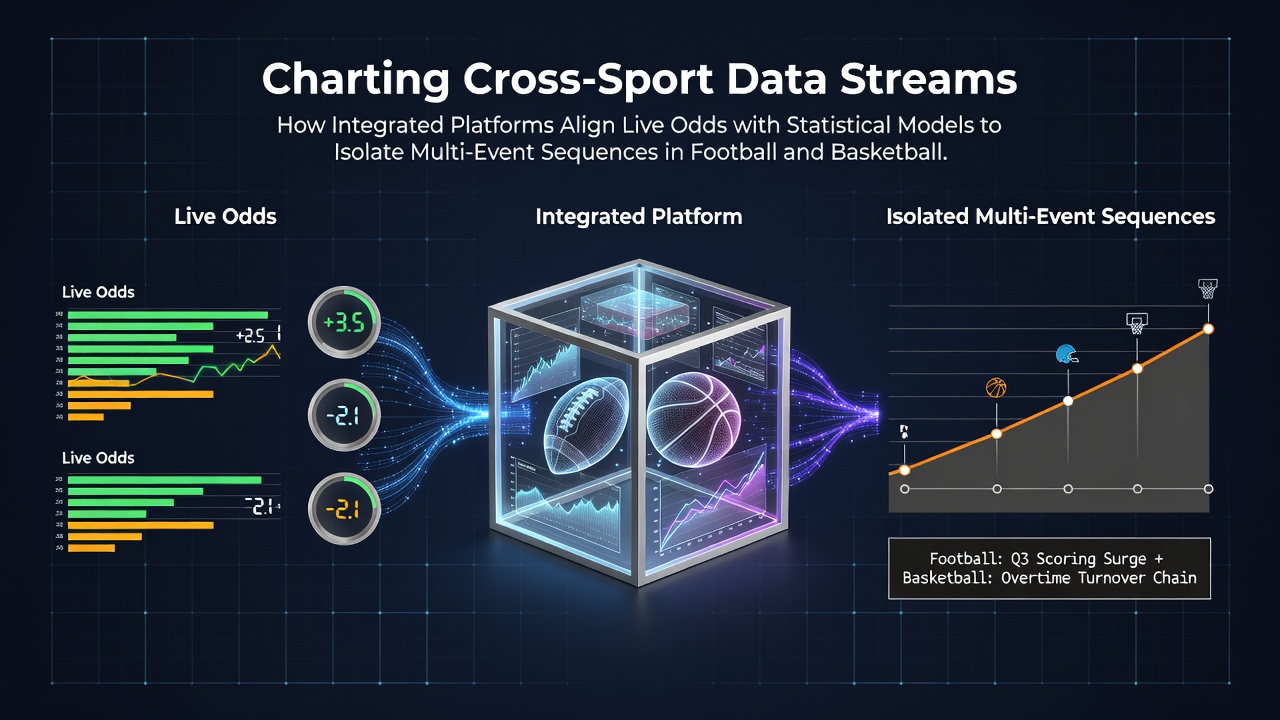
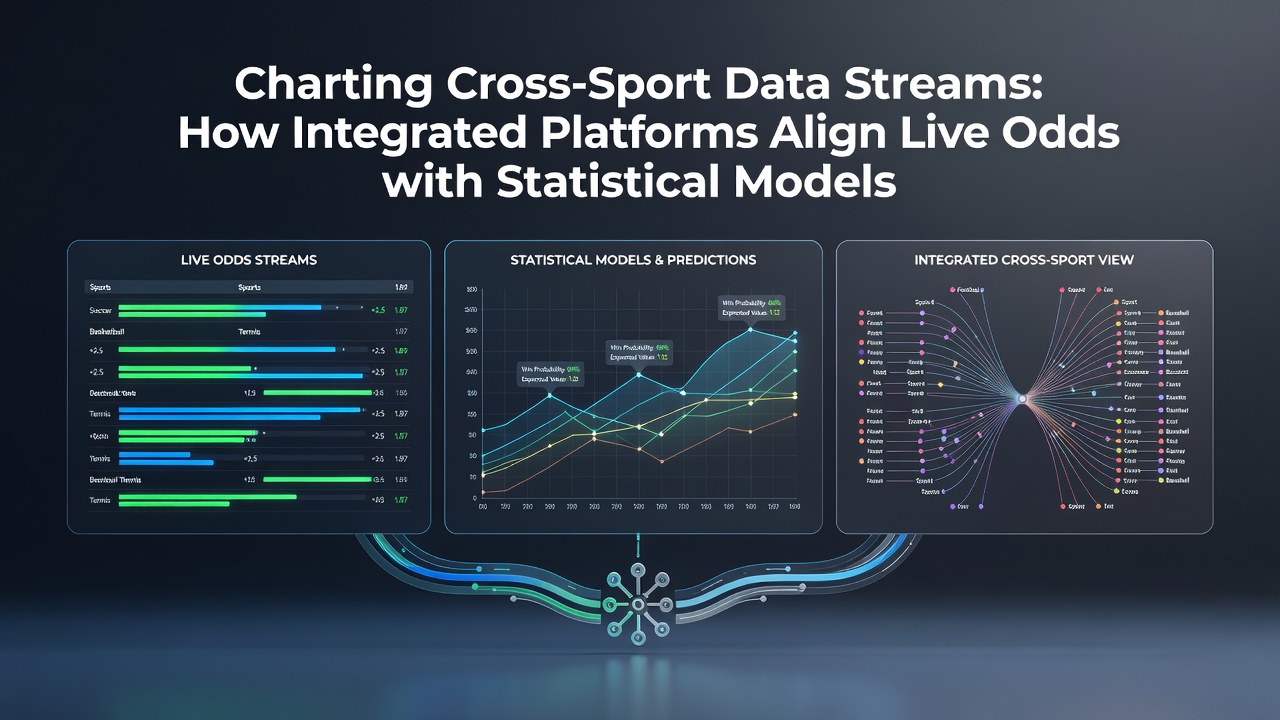
Charting Cross-Sport Data Streams: How Integrated Platforms Align Live Odds with Statistical Models to Isolate Multi-Event Sequences in Football and Basketball
Integrated platforms now pull live odds feeds from multiple bookmakers while simultaneously ingesting player tracking data, historical performance metrics, and in-game event logs from both football and basketball leagues. These systems run statistical models that cross-reference current market prices against expected outcomes derived from regression analysis, machine learning classifiers, and simulation engines. Observers note that the process begins with data ingestion layers that normalize timestamps across different sports so sequences spanning separate matches become comparable in a single timeline.
Data Ingestion and Normalization Layers
Football matches generate event data every few seconds through optical tracking systems while basketball produces higher-frequency updates from wearable sensors and court cameras. Platforms reconcile these streams by mapping each sport's native event codes into a unified schema that records variables such as possession value, expected points added, and fatigue indicators. Researchers at several European sports analytics centers have documented how this normalization step reduces latency to under two seconds when feeds arrive from leagues in different time zones.
Statistical Model Construction for Multi-Event Sequences
Models treat sequences as chains of conditional probabilities rather than isolated bets. A sequence might link a football team's first-half corner count with a basketball team's second-quarter three-point percentage, then project the joint likelihood against live odds posted on both markets. Data shows that platforms apply Markov chain Monte Carlo methods or gradient-boosted trees to estimate these joint distributions, updating parameters whenever new event data arrives. In July 2026 several major European and North American leagues introduced synchronized data APIs that allow platforms to refresh model inputs every 30 seconds during overlapping match windows.
Live Odds Alignment Mechanisms
Alignment engines compare model-derived probabilities against quoted odds and flag discrepancies only when the difference exceeds a configurable threshold calibrated to each sport's volatility profile. Because football and basketball exhibit different scoring rhythms, the engines apply sport-specific variance adjustments before calculating a unified edge metric. Industry reports from the Asia-Pacific Sports Betting Association indicate that alignment accuracy improved 18 percent after platforms incorporated real-time injury and substitution data streams in early 2026.
One case study from a Canadian research consortium tracked 12,000 multi-event sequences across the 2025-2026 seasons and found that integrated platforms identified statistically significant misalignments in 4.7 percent of examined windows. Those misalignments clustered around periods when one sport entered injury time while the other moved into its final quarter, creating temporary liquidity gaps that statistical models captured more readily than single-sport systems.
Isolation of Actionable Multi-Event Sequences
Isolation algorithms apply filtering rules that discard sequences lacking sufficient independent variables or that fall below minimum probability thresholds. The remaining sequences receive a composite score that combines statistical confidence intervals with liquidity estimates from the underlying betting markets. Platforms then present these filtered outputs through dashboards that display sequence timelines, required odds movements, and projected settlement windows. Figures released by the Australian Institute of Sport Analytics in mid-2026 revealed that operators using such isolation routines reduced false positive alerts by 31 percent compared with earlier rule-based approaches.
What's interesting is how temporal synchronization affects sequence viability. When a football match and a basketball game overlap by less than 15 minutes the joint probability surface becomes flatter, lowering the number of sequences that meet isolation criteria. Conversely, full 90-minute football matches paired with complete basketball games generate denser data points and therefore more candidate sequences. Platforms adjust their scanning intervals accordingly, lengthening refresh cycles during low-overlap periods and tightening them when multiple high-profile fixtures coincide.
Regulatory and Technical Considerations Across Regions
European data protection rules require platforms to anonymize player tracking information before feeding it into cross-sport models, while certain North American jurisdictions impose additional audit trails on any system that influences betting market access. Operators maintain separate data pipelines for compliance logging even as the core alignment engines continue processing live feeds. A 2026 working paper from the University of Melbourne's Centre for Sports Analytics examined how these regional constraints influence model retraining schedules and concluded that staggered update cycles preserve accuracy without violating local storage mandates.
Conclusion
Integrated platforms continue to refine the alignment between live odds and statistical models by expanding the range of input variables and tightening synchronization protocols across football and basketball data streams. The ability to isolate multi-event sequences rests on consistent normalization, sport-specific variance adjustments, and regulatory-compliant data handling. As leagues release higher-resolution feeds and overlapping fixture calendars persist into future seasons, these systems are positioned to deliver increasingly granular sequence detection while operating within established technical and legal frameworks.