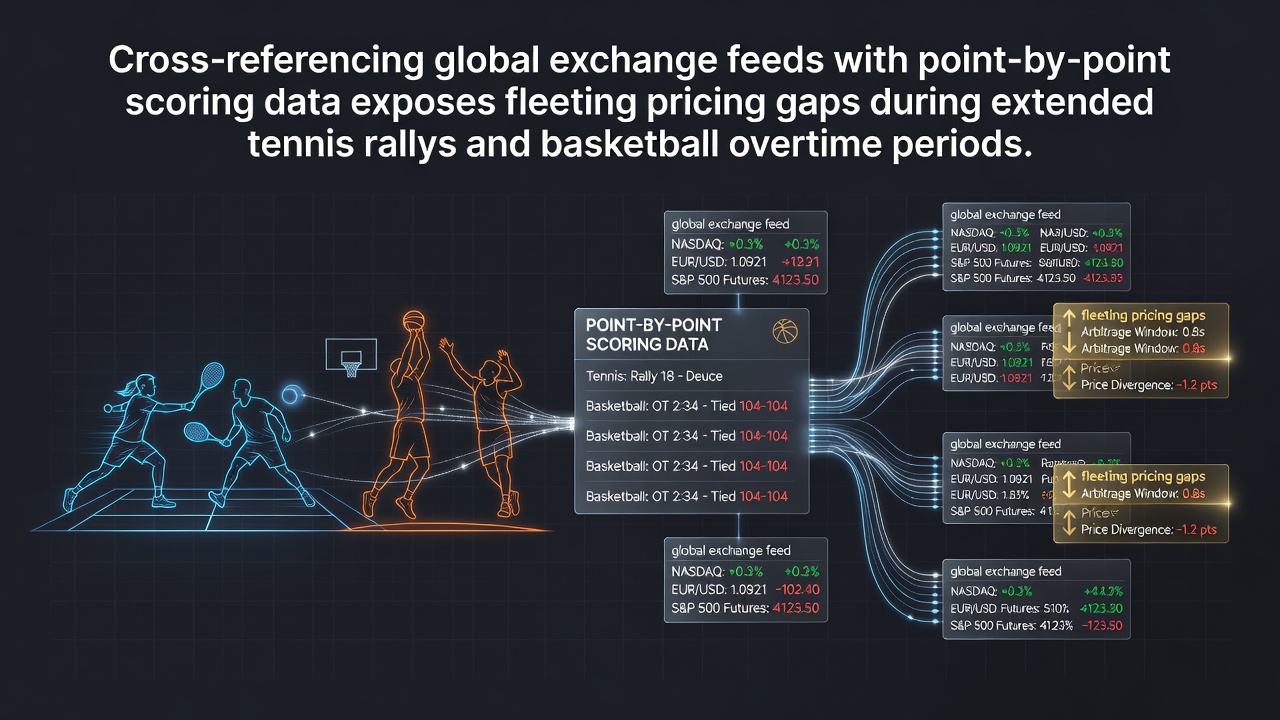
Exchange Feeds and Scoring Data Uncover Live Market Inefficiencies in Tennis and Basketball
Data analysts cross-reference global betting exchange feeds with detailed point-by-point scoring information to identify short-lived pricing inconsistencies that appear during prolonged tennis rallies and basketball overtime segments, and these patterns emerge because live odds adjust at different rates across platforms while actual match events unfold in real time.
Mechanics of Feed Integration and Scoring Alignment
Systems pull simultaneous data from multiple international exchanges and pair it with granular scoring feeds that track every point, serve, and possession change, while observers note that latency differences between sources create windows where implied probabilities diverge from the current state of play. Researchers at institutions such as the University of Nevada, Las Vegas have documented how these alignments function in high-volume markets, and their work shows that extended sequences amplify the effect because each incremental score update triggers uneven repricing across venues.
Algorithms scan for mismatches by comparing the latest exchange odds against the precise game state derived from scoring data, and this process runs continuously so that even rallies lasting twenty or thirty shots can produce measurable gaps before markets fully synchronize. Data indicates that basketball overtime periods generate similar effects when possession changes and foul calls occur rapidly, since different exchanges update their models at staggered intervals.
Patterns Observed in Extended Tennis Rallies
Long tennis rallies introduce repeated score increments that force exchanges to recalculate probabilities on every shot outcome, yet the timing of these updates varies by platform and region. One documented sequence from a major tournament in early 2026 illustrated how a fifteen-shot rally created a brief window where one exchange listed a player at 1.92 while another adjusted to 1.87 within seconds of the same point completion, and analysts traced the discrepancy to differing data refresh rates.
Those who monitor these feeds report that serve-and-volley exchanges or baseline attrition battles produce the most frequent gaps because each point alters momentum calculations differently across models. Cross-referencing reveals that the gaps close quickly once all platforms incorporate the same scoring update, which limits the duration but also highlights how consistent monitoring can capture the intervals when they exist.

Dynamics in Basketball Overtime Periods
Basketball overtime introduces sudden shifts in score differential and foul accumulation that exchanges must incorporate into their pricing, and the rapid sequence of possessions often outpaces the slowest feeds. Figures from North American market analyses released in June 2026 show that overtime segments lasting five or more minutes generate higher rates of transient inconsistencies than regulation play, particularly when teams trade leads on consecutive possessions.
Point-by-point data allows precise mapping of each scoring event to corresponding odds movements, and this mapping demonstrates that certain exchanges lag when incorporating timeout information or substitution effects. The result is a series of short-lived opportunities where implied probabilities do not yet reflect the updated game state across all venues simultaneously.
Technical Considerations and Data Sources
Global exchange networks operate across time zones and regulatory environments, which adds further variability to update speeds, while scoring data providers supply standardized feeds that serve as the common reference point. According to reports from the Canadian Gaming Association, integration of these streams requires low-latency connections and robust parsing rules to avoid false signals from delayed or incomplete updates.
Additional studies from Australian research centers have examined similar cross-referencing methods in other sports and found that the principle scales effectively to tennis and basketball because both feature discrete scoring events that can be timestamped with high precision. The approach relies on continuous comparison rather than static snapshots, which allows identification of gaps that last only fractions of a second in fast-moving sequences.
Conclusion
Cross-referencing global exchange feeds with point-by-point scoring data provides a method for detecting fleeting pricing gaps that arise during extended tennis rallies and basketball overtime periods, and the technique depends on synchronized data streams that account for variable update rates across platforms. Evidence from multiple regions continues to illustrate how these patterns manifest under specific match conditions, while ongoing refinements in data integration support more accurate identification of the intervals when inconsistencies occur.