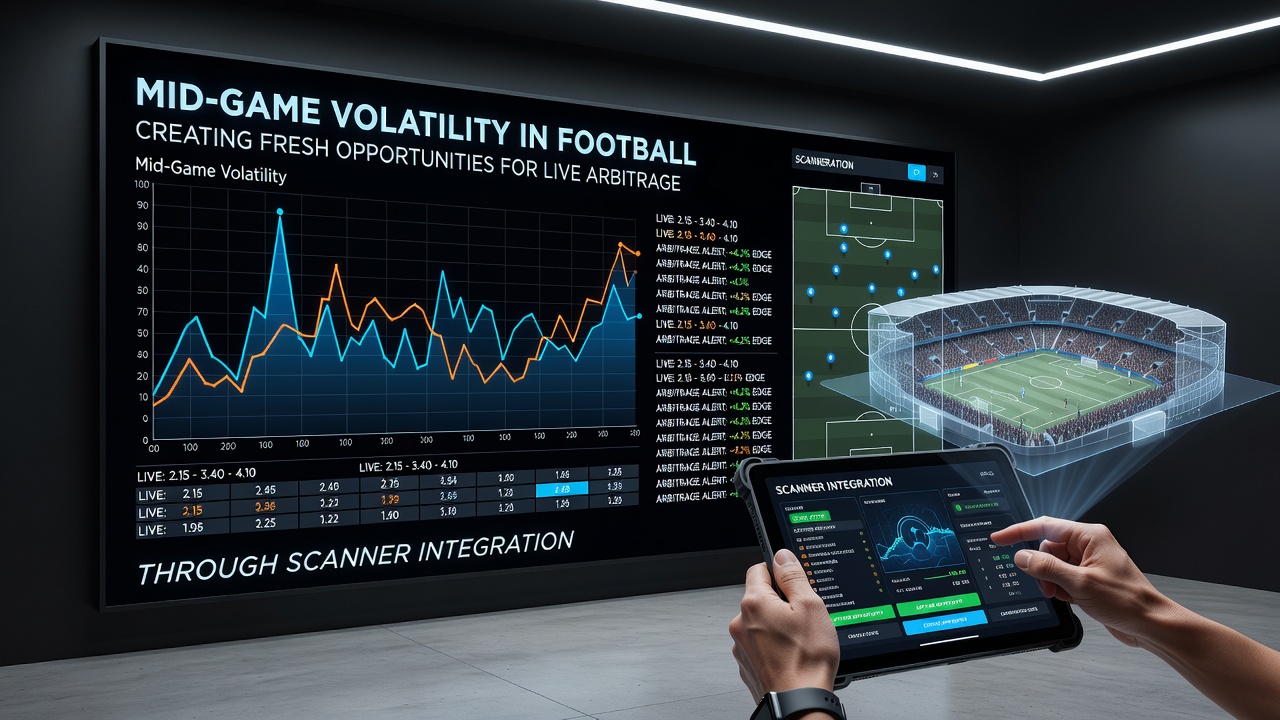
Football's In-Game Swings Generate Live Arbitrage Windows Through Scanner Integration
Football matches often see dramatic momentum shifts between the 30th and 70th minutes, periods when goal probabilities fluctuate rapidly due to substitutions, tactical adjustments, and player fatigue patterns that create measurable discrepancies across bookmaker odds. Data from major European leagues indicates these intervals produce higher variance in expected goals metrics compared to opening or closing phases, which in turn opens pathways for live arbitrage when scanners detect misalignments in real time.
Patterns of Volatility Across Major Leagues
Analysts tracking Premier League and Serie A fixtures have documented how red card incidents or rapid counter-attacks between minutes 35 and 65 frequently alter implied probabilities by 8 to 15 percent within a single minute, figures that exceed average movement thresholds recorded in pre-match markets. Scanner systems integrate multiple data feeds to flag these movements instantly, allowing operators to compare decimal odds across several platforms simultaneously while the variance remains elevated. Research from the University of Sydney's sports analytics group shows that mid-game volatility spikes correlate strongly with fixture congestion schedules, particularly during congested spring periods when teams rotate squads heavily.
Scanner Technology and Real-Time Data Fusion
Modern arbitrage scanners pull live feeds from over 40 bookmakers while cross-referencing expected goals models updated every 30 seconds, a process that isolates temporary pricing gaps before they normalize. These tools apply algorithmic filters to exclude low-liquidity markets and focus instead on high-volume lines such as next goal, Asian handicap, and over-under totals where liquidity supports rapid execution. Observers note cases where integrated scanner platforms identified a 2.3 percent edge in a Bundesliga match during a 47th-minute substitution window, enabling coordinated bets across three operators before odds converged within 90 seconds.
Execution Timing and Risk Controls
Successful live arbitrage hinges on execution speed measured in milliseconds, since football volatility windows close quickly once markets incorporate new information from pitch-side events. Automated calculators linked to scanner outputs compute stake distributions across opposing outcomes to lock in margins regardless of final result, while built-in latency checks prevent orders from reaching slower bookmakers after the window has narrowed. Industry reports from the Nevada Gaming Control Board highlight that operators using scanner-calculator combinations maintained positive expected returns across thousands of live football wagers during the 2025 season, provided position sizing stayed within predefined exposure limits.
June 2026 Tournament Implications
With the FIFA World Cup 2026 scheduled to begin in June, increased fixture density across international and club calendars is expected to amplify mid-game volatility as teams manage player workloads across multiple competitions. Scanners configured for tournament schedules can prioritize high-stakes knockout matches where tactical shifts occur more frequently after the first half, creating extended arbitrage intervals. Figures from the Canadian Gaming Association indicate similar patterns emerged during prior major tournaments, where live betting volumes rose 47 percent during middle stages compared to group-phase fixtures.
Market Depth and Liquidity Considerations
Not all football leagues offer sufficient depth for reliable live arbitrage, yet top-five European competitions maintain tight spreads even during volatile periods when scanner integration allows rapid identification of cross-bookmaker differences. Those who monitor Asian and South American domestic leagues report narrower windows overall, although scanner algorithms calibrated for lower liquidity can still surface opportunities when major clubs face relegation-threatened sides. External data streams from Opta and similar providers feed into these systems to refine probability models, reducing false positives that arise from unadjusted scoreline movements alone.
Conclusion
Mid-game volatility in football continues to supply measurable edges for live arbitrage when scanner systems fuse real-time data across multiple sources, yet consistent outcomes depend on disciplined execution protocols and ongoing calibration of volatility thresholds. As tournament calendars intensify through June 2026 and beyond, the integration of advanced scanning tools with automated calculators remains central to capturing these transient opportunities across global markets.