
Global Clockwork: Leveraging Time Zone Shifts for Edges in Multi-League Live Wagering Scenarios
Global sports wagering operates on a 24-hour cycle where leagues in different hemispheres open and close their markets at staggered intervals, and observers note that these shifts create brief windows where odds on identical events can diverge before they realign. Data from international betting exchanges shows that major basketball, soccer, and tennis competitions span more than a dozen time zones on any given weekend, which means live markets in Asia often begin pricing games hours before North American books adjust their lines.
How Time Differences Shape Market Timing
European soccer fixtures that kick off at 15:00 local time in the UK reach Asian bettors while those markets are still in early morning hours, and American sportsbooks have yet to open their overnight lines. Researchers tracking multi-book data feeds have documented that liquidity pools in one region can lag behind another by 30 to 90 minutes, producing temporary discrepancies that automated systems flag before manual traders react. The Australian Betting Exchange, for instance, often posts early totals on NBA games that later differ from lines released by operators in Nevada once US volume arrives.
Those who monitor overlapping schedules across continents have found that the transition periods around 02:00 to 06:00 UTC frequently coincide with the largest spreads between books, because fewer traders are active while key data such as injury reports or weather updates continue to surface.
Tools That Track Global Clockwork
Specialized software platforms aggregate real-time feeds from regulated operators in multiple jurisdictions and convert all timestamps into a single UTC reference. According to reports issued by the European Gaming and Betting Association, these platforms now incorporate machine-learning models trained on historical odds movement patterns tied to specific time-zone overlaps. The models identify when a Japanese baseball market opens four hours ahead of comparable North American books and flag potential edges that persist for an average of 47 seconds before correction occurs.
One study conducted at a Canadian university examined live wagering data from the 2025-2026 season and revealed that arbitrage opportunities across time zones appeared 1.8 times more frequently during daylight-saving transitions than during standard periods. The findings indicate that the abrupt one-hour shift disrupts routine pricing algorithms used by some operators.
Multi-League Examples in Practice
Consider a tennis match scheduled for 10:00 in Melbourne that overlaps with an NBA tip-off at 19:00 in Los Angeles. Bettors following both events can observe that Australian markets price set totals earlier than US basketball books adjust their player props, creating a brief period where correlated statistical models produce divergent implied probabilities. Scanners configured to watch both leagues simultaneously have recorded instances where the same underlying performance metric received different valuations solely because one market opened while the other remained closed.
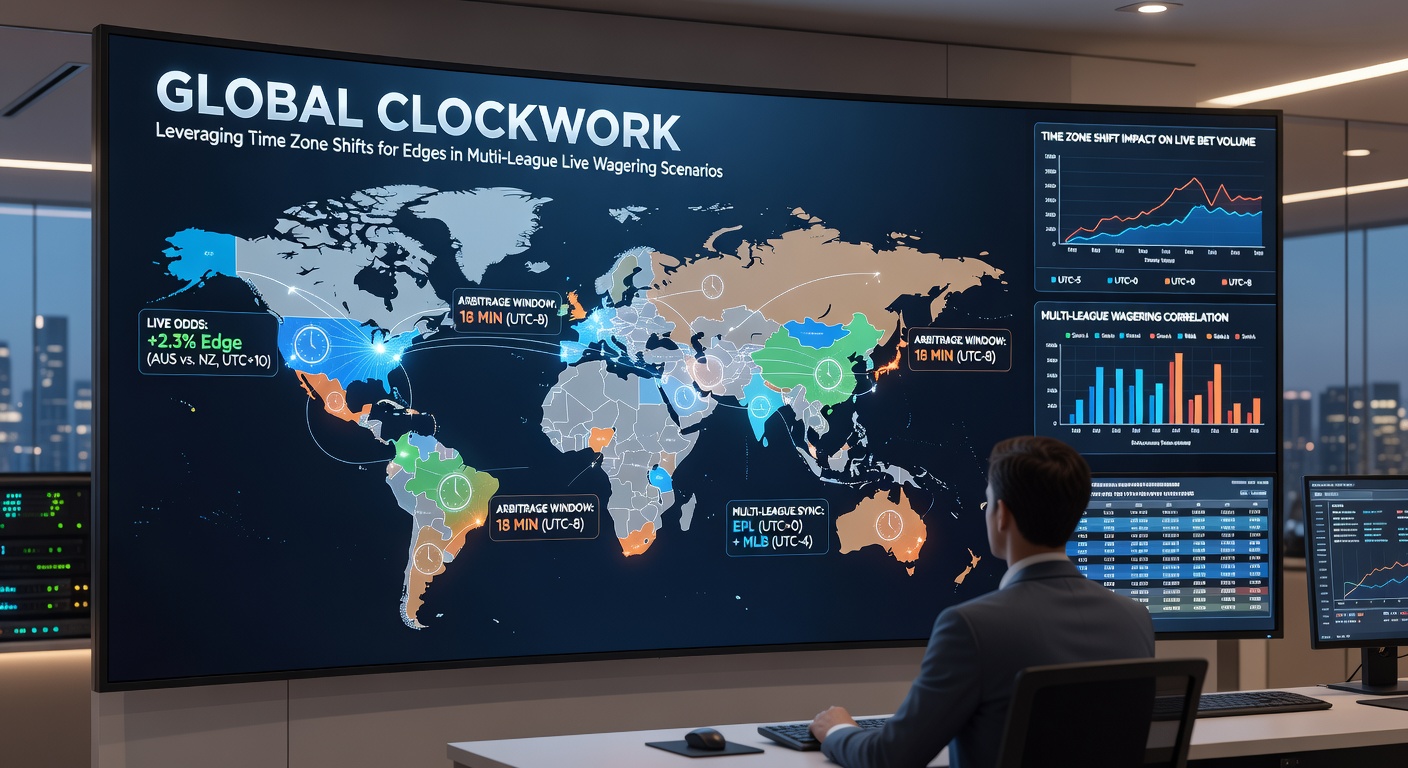
Industry data released in early 2026 shows that the volume of live wagers placed between 20:00 and 04:00 UTC rose 14 percent compared with the same window in 2025, a period that includes the conclusion of several Asian soccer leagues and the start of European evening fixtures. Analysts attribute part of the increase to improved synchronization tools that allow traders to act across staggered market openings.
Regulatory Context Across Regions
Authorities in different jurisdictions approach these timing dynamics with varying levels of oversight. The Nevada Gaming Control Board requires operators to maintain audit logs of all live odds changes, including those influenced by international feeds, while Australian state regulators focus on ensuring that local books do not inadvertently import mispriced lines from overseas exchanges. These differing requirements mean that compliance teams must map their own operational hours against global event calendars to avoid unintended exposure during transition windows.
Figures released by the Asia-Pacific Gaming Association indicate that cross-border data sharing agreements between licensed operators have expanded in 2026, partly to reduce the duration of pricing mismatches that arise from time-zone offsets. The agreements include standardized reporting formats that timestamp every odds revision in UTC, which in turn supports more precise detection of anomalies that occur during low-liquidity overnight periods.
Conclusion
Time-zone differentials continue to influence the structure of live wagering markets as operators and technology providers refine their synchronization methods. Data collected through 2026 shows measurable patterns tied to daylight-saving changes and staggered league schedules, while regulatory frameworks in multiple regions adapt their reporting standards to accommodate these global clockwork effects. The interplay between market openings in one hemisphere and active trading hours in another remains a measurable factor in how odds evolve across interconnected events.